
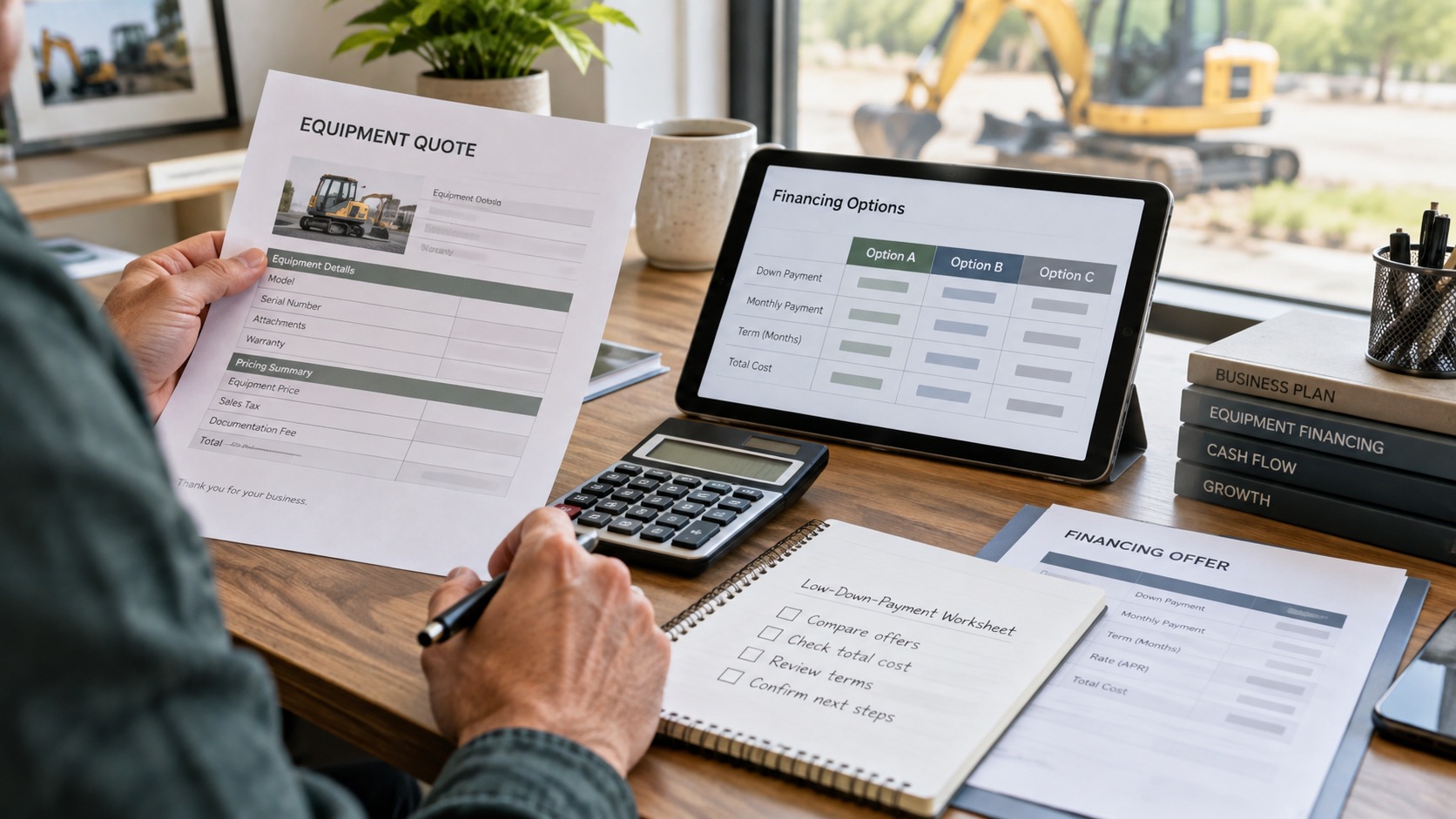
Equipment financing without a large down payment can work when the equipment is clearly identified, the business has enough cash flow to support the full payment, and the offer shows the real cash due at signing. A low down payment is not automatically a cheaper deal. It usually means the business finances more of the purchase price, so the monthly payment, total repayment, payoff rules and working-capital cushion matter more than the headline "zero down" label.
The right question is not only "Can I avoid a big deposit?" It is "What does preserving cash cost, and does the business still have enough reserve after the equipment arrives?" A $0-down structure can be sensible when cash is needed for payroll, insurance, inventory, repairs or ramp-up costs. It can be dangerous when the payment only works in the best month, the asset is hard to resell, or fees and first payments make the closing cash look smaller than it really is.
What current results show
Current U.S. and Texas results for this keyword are commercial and late-stage informational. Top pages usually use phrases like "no money down," "100% financing" and "low or no down payment." They tend to include quick answers, qualification tables, down-payment examples, credit and time-in-business requirements, equipment-type guidance, FAQs, calculators and application CTAs. The SERP is useful, but also sales-heavy, so readers need a practical filter.
Axiant Partners' zero-down guide frames no-money-down financing around stronger credit, operating history, revenue stability and equipment resale value. U.S. Bank's equipment financing page says its equipment financing can require no down payment, offers terms from 24 to 60 months and may include certain additional costs such as installation, tax and freight. Those details are helpful because "no down payment" can still leave other costs to clarify.
Official sources shape the boundaries. The SBA 7(a) program can be used for purchasing and installing machinery and equipment when program and lender requirements are met. The IRS depreciation guidance explains that depreciable property generally must be owned, used in business or income-producing activity, and have a determinable useful life. That matters because a low-cash lease, loan or equipment finance agreement can create different ownership and tax questions. This article is general education, so ask a qualified adviser about a specific contract.
Seven ways to reduce the upfront cash requirement
| Option | Best fit | What to confirm before signing |
|---|---|---|
| 100% equipment financing | Established businesses buying identifiable equipment with strong resale value and clean seller paperwork. | Total cash due at signing, whether taxes/freight/install are included, payment frequency, rate or APR, fees and payoff rules. |
| Low-down-payment equipment loan | Borrowers who can put some cash down but need to preserve most operating reserves. | Whether 5% or 10% down materially improves pricing, approval odds or term compared with $0 down. |
| Vendor or dealer financing | New equipment from a dealer that can coordinate quote, warranty, delivery and finance documents. | Cash price versus financed price, promotion deadlines, deferred-payment terms, service plan and whether the vendor is marking up the financing. |
| Equipment lease | Technology, vehicles or equipment with upgrade cycles where ownership is less important than monthly cash flow. | Buyout, residual value, renewal rules, return condition, maintenance duties, taxes and end-of-term obligations. |
| SBA-backed loan path | Larger planned projects where equipment is part of a broader eligible business purpose and timeline is flexible. | Eligibility, borrower contribution, fees, collateral, allowed uses, documentation and closing timeline. |
| Equipment finance agreement | Borrowers who want a structured equipment purchase with streamlined documentation and ownership-like economics. | Title language, security interest, non-cancelable terms, prepayment limits, insurance requirements and total finance charge. |
| Split equipment and working capital | Projects where the asset and the cash reserve need different financing tools. | Combined monthly obligation, lien conflicts, total cost and whether two products create more risk than one larger down payment. |
1. True 100% financing
True 100% equipment financing means the lender funds the full equipment invoice. It is most realistic when the borrower and the asset both reduce lender risk: established revenue, organized bank statements, acceptable credit, clear ownership, a reputable seller and equipment with a normal resale market. Standard construction machines, titled commercial vehicles, forklifts, manufacturing machinery, medical equipment and some restaurant or office equipment can be easier to underwrite than custom or fast-obsolescing assets.
The catch is that "100% of the invoice" may not mean "nothing leaves the bank account." Ask whether first payment, last payment, documentation fee, UCC filing fee, insurance, delivery, training, taxes or installation are due separately. If the offer finances soft costs, ask how much and whether the balance starts above the equipment's hard value. That can matter if you sell, refinance or pay off early.
2. A smaller down payment that improves the file
Sometimes the best low-cash structure is not zero down. A modest down payment can improve a borderline application, reduce the amount financed and show the lender that the owner has cash invested in the asset. This can be especially useful for used equipment, private-party sellers, newer businesses or borrowers with uneven credit. The key is to compare the written offer with and without the down payment.
Do not put every dollar into the deposit. Keep a reserve for insurance, delivery, installation, repairs, payroll and the first slow month after the equipment arrives. The equipment financing requirements guide explains why down payment is only one part of underwriting. Cash flow, equipment value, seller documents and business history still matter.
3. Dealer or vendor financing
Dealer financing can reduce friction because the seller already has the quote, equipment details and delivery process. It can also make a low-down-payment promotion easier to execute, especially on new equipment. This is common in categories such as trucks, construction machinery, agricultural equipment, medical devices, fitness equipment and office technology.
Convenience is not the same as best cost. Compare the cash price with the financed price. Ask whether rebates disappear if you finance, whether service contracts are bundled, whether deferred payments create a cliff, and whether the promotion changes after a short introductory period. A vendor program can be useful, but it should still compete against an outside equipment finance quote.
4. Leasing when ownership is not the only goal
A lease may reduce upfront cash and preserve upgrade flexibility. That can fit equipment with a short technology cycle, uncertain long-term use or planned replacement schedule. It can also fit businesses that care more about use than ownership. A fair market value lease, $1 buyout lease and operating lease can feel similar month to month but end very differently.
Before using leasing only to avoid a deposit, read the buyout and return language. Ask who maintains the equipment, who insures it, what happens if it is damaged, whether there is an automatic renewal, and how the business exits early. The guide to equipment loans versus leases can help compare ownership, useful life and end-of-term risk.
5. SBA-backed financing for planned projects
SBA-backed lending is not a magic zero-down button. It can be useful when the project is larger, planned and documentation-heavy. A 7(a) loan may support equipment along with other eligible business uses. A 504 loan can support certain long-term machinery and equipment through Certified Development Companies, but it is not for working capital and has its own structure.
The tradeoff is time and paperwork. If the equipment is a replacement asset needed next week, a faster equipment finance offer may be more practical. If the project is a larger expansion, SBA-backed options may deserve a place in the comparison. Keep the timing honest so a slower approval does not cost more than a larger down payment would have.
6. Financing soft costs carefully
Some lenders can include taxes, freight, installation, training, warranty, software or setup costs. That can reduce cash due at closing and make the purchase easier to execute. It can also make the financed balance larger than the equipment's standalone value. If the asset takes time to generate revenue, rolling in soft costs may be sensible. If the business may sell or refinance early, it may be expensive.
Separate hard equipment cost from soft costs before applying. A $90,000 machine with $12,000 in freight, installation and tax is not the same underwriting problem as a $90,000 machine alone. Ask which costs are eligible, which must be paid out of pocket and whether including them changes rate, term or approval.
7. Protecting cash with a separate reserve plan
Sometimes the down payment is not the real problem. The problem is that the business needs the asset and a cushion. In that case, compare the equipment financing with a separate working-capital reserve, line of credit or staged purchase. Two products can create more complexity, but one over-stretched equipment agreement can be worse.
Model the combined obligation. If you keep cash by choosing a low-down-payment option, decide exactly what that cash is for. Payroll, inventory, ramp-up marketing, repairs, insurance deductibles and slow receivables are real uses. Leaving cash idle while paying a large rate premium may not be worth it.
How to judge the low-down-payment tradeoff
Start with total cash due at signing. This number should include down payment, deposits, first payment, last payment, documentation fees, filing fees, delivery, taxes, insurance, escrow, inspection and any required reserves. If a provider advertises no money down but requires two payments and fees before funding, treat that as upfront cash in your comparison.
Next, compare monthly payment and total repayment. A lower deposit usually means financing more money. That can raise the payment, extend the term or increase total cost. Use the framework in equipment financing rates explained so you do not compare only the monthly payment. A zero-down quote with daily or weekly repayment can strain cash faster than a slightly larger deposit with a monthly schedule.
Then match the term to useful life. Financing an asset longer than it will reliably produce value can leave the business paying for equipment that is obsolete, broken or already sold. IRS depreciation rules are not the same as lender term rules, but both push owners to think about business use and useful life. If the equipment will wear out quickly, a lower upfront cost may not justify a long obligation.
Finally, stress-test the first six months. What if the equipment arrives late, installation takes longer, the first jobs are delayed, a customer pays slowly, or a used machine needs repairs? Low-down-payment financing is supposed to protect cash, not erase the need for it. If the business has no cushion after closing, the structure may be too aggressive even if approval is possible.
Low-down-payment offer checklist
Before accepting a low-cash offer, ask for the full structure in writing. A serious comparison should include amount financed, cash due at signing, equipment cost, soft costs included, fees, payment amount, payment frequency, term, APR or finance charge when available, total repayment, collateral, lien scope, guaranty, insurance, delivery conditions, seller funding process, prepayment rules and ownership outcome.
Also prepare the file before you apply. Lenders will usually want an equipment quote or invoice, seller legal name, seller contact, year, make, model, serial number or VIN when available, condition, hours or mileage for used equipment, business bank statements, ownership information, entity details, insurance contact and a short explanation of how the equipment supports repayment. If credit is challenged, the article on financing equipment with bad credit explains how compensating factors can help a file without promising approval.
Equipments Finance can be one comparison point for business owners who already have a real equipment quote and want to understand how much cash a transaction may require at closing. That is not a guarantee of approval or terms. It is a practical reason to bring the quote, seller details and cash-flow questions into the credit application instead of shopping from a headline alone.
FAQ
Can I get equipment financing with no large down payment?
Some borrowers can, especially when the business is established, cash flow is steady, the equipment has resale value and the seller documentation is clean. Low down payment is not guaranteed and may increase monthly cost.
Is zero-down equipment financing the same as nothing due at signing?
No. Some offers finance the full equipment invoice but still require first payment, last payment, fees, taxes, freight, insurance or documentation costs before funding. Always ask for total cash due at signing.
What equipment is easiest to finance with a low down payment?
Lenders are usually more comfortable with equipment that has a clear invoice, identifiable make and model, useful remaining life, stable resale demand and clean title or seller records.
Does a lower down payment mean a better deal?
Not automatically. A lower down payment preserves cash, but it can mean a larger balance, higher payment, more interest, stricter terms or less equity if the business needs to sell or refinance early.
Should a startup use low-down-payment equipment financing?
A startup should be careful. Low cash at closing may help preserve reserves, but newer businesses often face narrower lender choices and higher documentation needs. Stress-test the payment before signing.