
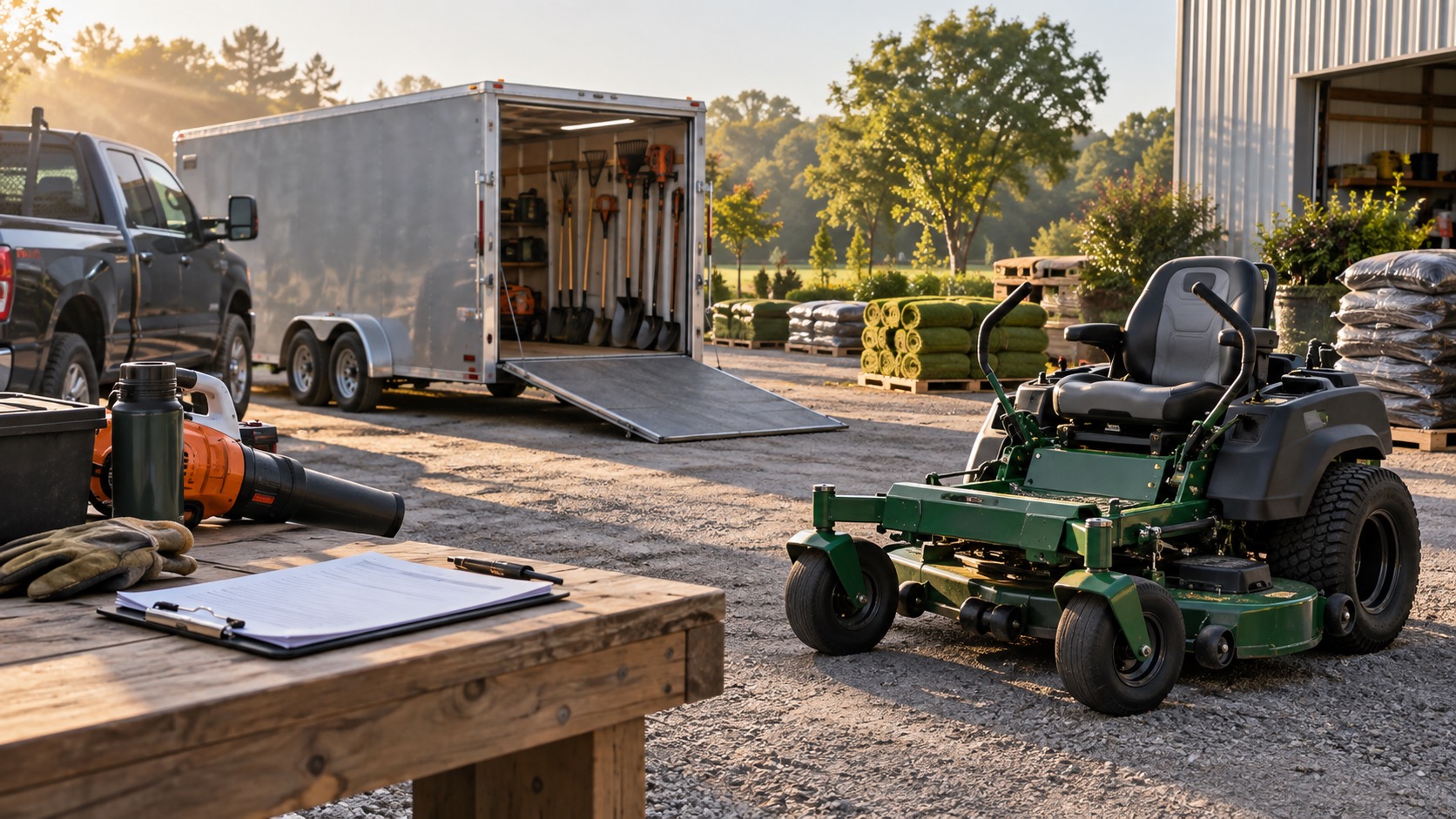
The best landscaping equipment financing option is the one that fits the asset, crew size, seasonality, useful life, down payment, ownership goal and cash-flow cycle. A one-crew lawn care company buying a zero-turn mower, a growing landscaper adding an enclosed trailer and compact tractor, an irrigation contractor buying trenching equipment and a snow-removal operator financing plows or salt spreaders may all need different structures. Start by comparing seven routes: equipment financing, a bank or credit union loan, dealer or manufacturer financing, SBA-backed financing, a marketplace or broker, leasing, and a working-capital line when the issue is timing rather than the equipment itself.
Landscaping purchases are often packages, not isolated assets. A mower may need a trailer. A trailer may need racks, tie-downs and insurance. A skid steer may need attachments. Irrigation work can require trenchers, boring tools, pipe-pulling equipment and service vehicles. Seasonal crews may also need payroll, fuel, maintenance, storage and repair reserves before revenue arrives. A financing offer that looks affordable on the equipment invoice can still be a poor fit if it ignores those surrounding costs.
What current results cover
Current U.S. results for landscaping equipment financing mix lender landing pages, small-business financing guides and broader equipment-loan explainers. Strong pages usually answer which products can finance lawn care equipment, compare loans and leases, discuss credit and documentation, and explain why seasonal cash flow matters. The most useful results do not treat a zero-turn mower, dump trailer, compact tractor, plow truck and irrigation trencher as the same risk.
Industry-specific results often focus on loan term and repayment fit. The National Association of Landscape Professionals article on choosing an equipment loan emphasizes weighing short-term and long-term structures against cash flow, equipment life and overall business needs. Broad finance guides such as Nav's landscaping equipment financing article frame the decision around equipment loans, business loans and credit options for lawn care or landscaping owners.
Official sources are useful for guardrails. The SBA 7(a) program page explains that SBA-guaranteed loans are made by participating lenders and can support eligible business uses. The SBA 504 page includes long-term machinery and equipment among possible fixed-asset uses when program requirements are met. For tax treatment, IRS Publication 946 explains depreciation rules for business property; a landscaping owner should still ask a tax professional how a specific loan, lease or equipment package should be handled.
Best landscaping equipment financing options
| Option | Best fit | What to check before signing |
|---|---|---|
| Equipment finance company | Defined mowers, trailers, compact equipment, attachments, irrigation tools or snow equipment with clear seller quotes. | Eligible soft costs, down payment, seasonal payment timing, lien language, payoff terms, insurance requirements and total repayment. |
| Bank or credit union loan | Established landscaping companies with organized financials, bank history and planned purchases. | Collateral scope, blanket liens, underwriting timeline, personal guarantee, covenants and whether the term matches equipment life. |
| Dealer or manufacturer financing | New equipment bought through a mower, trailer, compact equipment or attachment dealer that can coordinate quote and delivery. | Cash price versus financed price, promotions, warranty, service agreement, delivery, setup fees and end-of-term language. |
| SBA-backed financing | Larger planned purchases, multi-asset expansion, owner-operator growth or projects that include equipment plus working capital. | 7(a) versus 504 fit, eligibility, borrower contribution, fees, documentation, collateral and closing timeline. |
| Marketplace or broker | Owners comparing lender types, newer businesses, mixed-credit files or packages with several asset categories. | Final lender identity, product type, broker compensation, hard-credit timing, payment cadence and total cost. |
| Lease | Equipment with upgrade cycles, seasonal use or owners who want flexibility around ownership at the end of the term. | Purchase option, renewal rules, return condition, maintenance, insurance, taxes and mileage or hour assumptions when relevant. |
| Line of credit or working-capital loan | Fuel, payroll, repairs, deposits, materials and short-term gaps around the equipment purchase. | Draw fees, repayment frequency, renewal risk, whether it is secured, and whether it solves cash timing rather than asset ownership. |
1. Equipment finance company
An equipment finance company can be a practical first stop when the purchase is tied to specific landscaping assets. This may include zero-turn mowers, stand-on mowers, walk-behind mowers, trailers, compact tractors, skid steers, mini excavators, trenchers, stump grinders, aerators, sprayers, snow plows, salt spreaders, attachments and jobsite support equipment. The lender reviews the asset, seller, price, business use, age, condition and repayment ability.
This route is strongest when the file is concrete: an itemized quote, seller contact, equipment description, model year, serial number if available, delivery timing and a short explanation of how the equipment supports jobs. Equipments Finance is based in Garland, Texas and can be one comparison point for owners reviewing landscaping purchases alongside construction equipment financing, agricultural machinery financing or other commercial equipment categories. That is a factual company mention, not a guarantee of approval, pricing or terms.
2. Bank or credit union loan
A bank or credit union may fit established landscapers with several seasons of revenue, organized bookkeeping, predictable deposits and enough time for conventional underwriting. Banks can be useful when the owner wants a broader relationship or when the project includes a vehicle, trailer and equipment package that needs a more traditional loan review. Some banks may also discuss SBA-backed options.
The tradeoff is process. A bank may ask for tax returns, interim financials, bank statements, debt schedules, entity documents, collateral details and information about existing liens. Confirm whether the bank understands seasonal revenue. Monthly debt service may be easy in spring and tight in winter. If the lender wants broad collateral or a blanket lien, compare that against a narrower equipment-backed structure before signing.
3. Dealer or manufacturer financing
Dealer financing can be convenient because the quote, delivery, warranty and financing conversation happen in one place. This can work well for new mowers, compact equipment, attachments, utility vehicles and trailers. Dealers may understand common landscaping packages and can often provide the itemized invoice lenders need.
Convenience still needs comparison. Ask for the cash price, financed price, down payment, fees, payment start date, warranty, service agreement, delivery, setup and any promotional conditions. A low advertised payment may depend on a specific term, credit profile or purchase amount. For used machines, compare a broader used equipment financing path because age, condition, seller documentation and remaining useful life can change underwriting.
4. SBA-backed financing
SBA-backed financing can be worth exploring when landscaping equipment is part of a larger planned expansion. A 7(a) loan may fit an eligible business purpose that includes equipment plus working capital, hiring, vehicles or other needs. A 504 loan may be relevant for long-term fixed assets when program requirements are met and the equipment has enough useful life.
The limitation is timing. SBA financing is handled through participating lenders and can involve eligibility review, ownership information, financial statements, collateral review and closing documents. That can be a good tradeoff for a planned multi-crew expansion or major fleet upgrade. It is usually less practical for a mower replacement that must be funded quickly to keep jobs on schedule.
5. Marketplace or broker
A marketplace or broker can help when the owner does not know which lender category fits. Landscaping files vary widely. One business may have strong deposits but short time in business. Another may have a seasonal dip, older equipment, a private-party trailer or a mixed package that includes mowers, attachments and a truck. A comparison process may surface equipment lenders, term-loan providers, lease options or SBA lenders that the owner would not find alone.
After receiving offers, identify the actual lender and product. Confirm whether the offer is an equipment finance agreement, lease, term loan, line of credit, sales-based product or brokered offer. Payment frequency, prepayment rules, broker compensation, collateral and total repayment matter as much as the headline approval. For a broader lender-preparation view, read what lenders look for in equipment deals.
6. Lease
Leasing can fit equipment that may be upgraded, replaced or returned before long-term ownership is clearly valuable. Some landscaping owners prefer leasing for technology-heavy machines, seasonal equipment, specialized attachments or equipment they expect to refresh as crew capacity changes. The payment can be easier to budget, but the end-of-term language matters.
Review the purchase option, renewal rules, return duties, maintenance obligations, insurance, taxes and whether hour limits or condition rules apply. A lease can be useful, but it is not automatically cheaper than a loan. For ownership tradeoffs, compare equipment loan vs equipment lease before choosing the structure.
7. Line of credit or working-capital loan
Sometimes the equipment is not the only problem. A landscaping company may need fuel, payroll, materials, repairs, insurance, deposits or marketing before customer payments catch up. A line of credit or short-term working-capital loan can help with timing gaps, especially before the busy season, but it should not be confused with long-term equipment ownership financing.
Use working capital for short-lived needs. Use equipment financing for durable assets when the repayment term matches the asset's useful life. If a lender proposes a short repayment schedule for a machine that should serve the business for years, compare total cash impact carefully. The goal is not only approval. The goal is a payment structure the crew can carry through real weather, repairs and seasonality.
How to match financing to seasonality
Start with the season when the equipment will earn money. A mower bought before spring cleanup has a different repayment story than a plow bought before winter or a skid steer bought for hardscape work with signed jobs. If the new asset replaces downtime, the case may be clearer. If it adds capacity for a new crew, the business needs enough confirmed demand, labor and routing discipline to turn the machine into revenue.
Next, separate hard equipment from surrounding costs. A zero-turn mower, trailer, racks, handheld tools, insurance, fuel cans, uniforms, software and payroll do not all behave the same way. Some may be financeable in an equipment structure. Others may need cash reserves or working capital. Mixing every cost into one payment can be simple, but it can also stretch short-lived expenses across too long a term.
Then match term to useful life. A commercial mower with heavy seasonal hours may have a shorter economic life than a trailer. A skid steer or compact tractor may last longer but require attachments, maintenance and transport. Irrigation equipment, trenchers and snow-removal gear can be seasonal. The term should reflect realistic use, not the longest payment schedule available.
Finally, keep repair and replacement reserves visible. Landscaping equipment works outside, travels between jobs and often runs hard during peak months. A financing offer that leaves no room for blades, tires, belts, hydraulics, trailer repairs or unexpected downtime may create cash-flow stress even if the monthly payment looks reasonable.
Documents to prepare before applying
Prepare the equipment quote, seller contact, equipment description, model year, serial number if available, delivery date, down payment requirement, warranty or service agreement, title information for trailers or vehicles, photos for used equipment and any attachment list. If the equipment is private-party or auction-sourced, gather ownership proof and lien information when available.
The business side matters just as much. Lenders may request ownership information, tax ID, bank statements, tax returns, profit and loss statements, debt schedule, insurance details, customer contracts, route density notes or a short explanation of seasonal revenue. Explain how the equipment supports repayment: faster route completion, more crews, higher-margin jobs, reduced repairs, added snow work, irrigation installs or less reliance on rentals.
Before signing, compare written offers in one table. Include amount financed, cash due upfront, term, payment frequency, fees, eligible costs, collateral, personal guarantee, seasonal payment flexibility, buyout or payoff language, total repayment and timing. When the quotes are ready, the credit application gives owners a starting point for an equipment review.
FAQ
What is the best landscaping equipment financing option?
The best option depends on the equipment, seller, crew size, seasonality, cash flow and ownership goal. Most owners should compare equipment financing, dealer financing, bank loans, SBA-backed paths, marketplaces and leasing before signing.
Can a new landscaping business finance equipment?
Sometimes. Newer businesses may face more documentation, higher down payment expectations or fewer lender choices. Strong owner experience, clear quotes, business bank statements, signed work, collateral and a realistic repayment plan can help the conversation.
Can financing include trailers and attachments?
Often, yes, if the trailer or attachment is clearly tied to business equipment use and the lender accepts it. Owners should separate trailers, racks, attachments, setup and soft costs so each lender can say what is eligible.
Is leasing better than buying landscaping equipment?
Leasing can help when upgrade flexibility matters or when the owner does not want long-term ownership. Buying can make more sense for durable assets the business expects to use for years. Compare end-of-term rules and total cost before deciding.
How should seasonal businesses compare payments?
Compare payments against conservative monthly cash flow, not only peak-season revenue. Look at slow months, weather risk, maintenance, payroll, fuel and insurance. Ask whether the lender offers seasonal structures, but do not assume every lender does.