
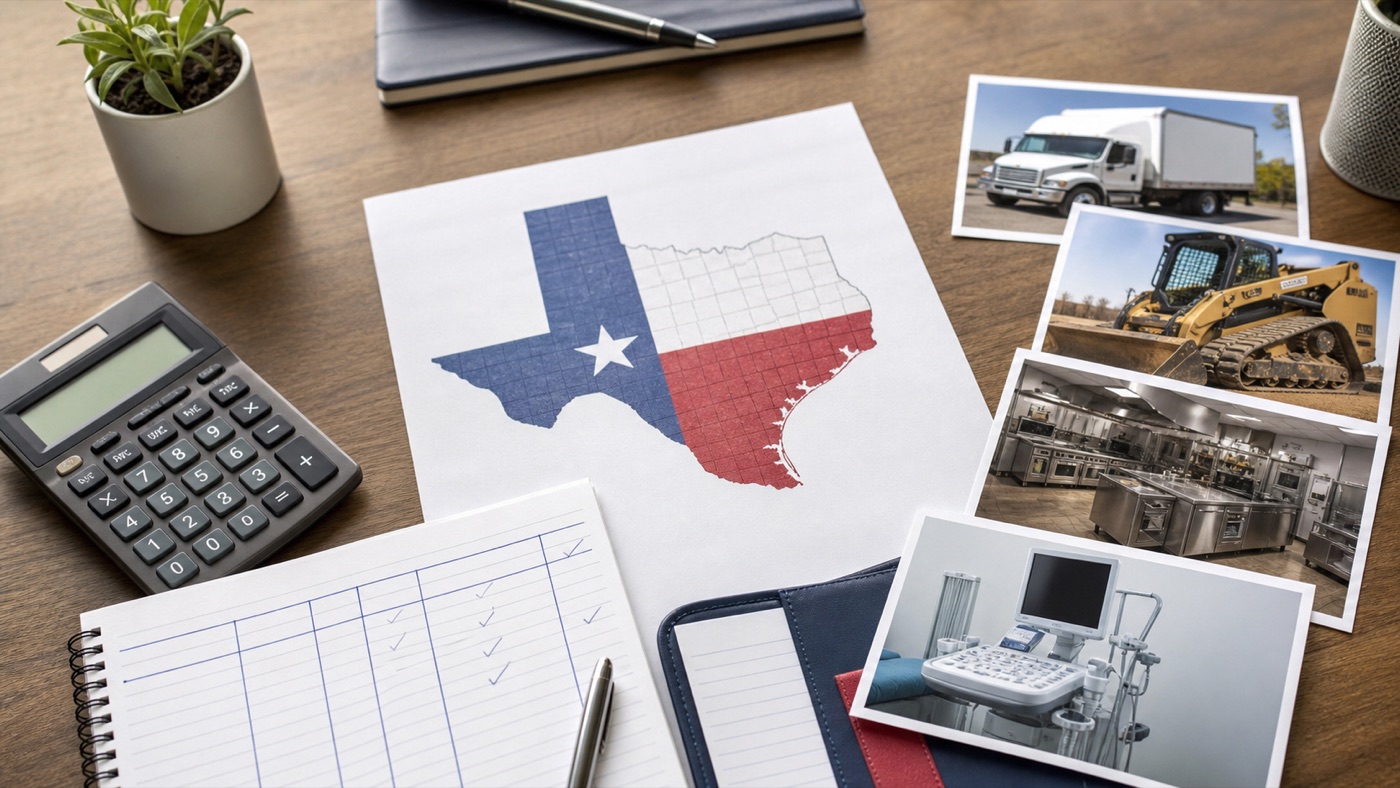
The best equipment financing company in Texas depends on the purchase. A Garland contractor replacing a skid steer, a Houston restaurant adding kitchen equipment, a Dallas medical office buying diagnostic machines and a trucking business financing a used box truck may all need different lender paths. The right comparison is whether the provider understands the asset, can work with the seller timeline, explains the structure clearly and gives the business a payment it can operate with after delivery.
For many Texas business owners, the strongest first move is to compare at least three categories: a Texas-based equipment finance contact or broker, a national marketplace for breadth, and a bank or SBA path if the borrower has the documentation and time. That mix reduces the risk of choosing the first fast quote without understanding total cost, ownership, payoff terms or documentation conditions.
What the current SERP shows
Search results for this topic are mostly BOFU comparison pages. The first relevant results emphasize listicles, lender tables, qualification factors, rates or ranges where available, loan amounts, speed, credit profile and FAQs. The local Texas angle is thinner than the national equipment-loan SERP, which creates an opportunity: Texas owners need the same comparison table, but with more attention to local industries, seller urgency, Texas-based support, SBA resource partners and the difference between equipment loans, leases and sales-based financing products.
The current SERP also shows a pattern of broad national recommendations. Buy Side from The Wall Street Journal maintains a current business equipment loans comparison with marketplace, direct-lender and mission-focused lender examples. Government sources add the guardrails: the SBA says 7(a) loans can be used for machinery and equipment, and 504 loans can finance long-term machinery and equipment that meet program requirements. The IRS explains depreciation rules separately in Publication 946, which is useful because tax treatment should not be guessed from a lender quote.
One Texas-specific gap is disclosure awareness. Equipment financing is not the same product as a merchant cash advance, but Texas businesses comparing fast funding should ask for the total repayment amount, finance charge, payoff terms and payment schedule before signing.
Best equipment financing options in Texas
| Option | Best fit | Texas-specific watch-out |
|---|---|---|
| Equipments Finance | Texas owners who want a practical local conversation around a real quote, seller deadline and equipment category. | Use it as one comparison point, not the only quote. Approval, terms and pricing still depend on underwriting. |
| Lendio | Borrowers who want to compare multiple lender categories from a marketplace before choosing a path. | Marketplace matches vary. Review the final lender, product type, repayment frequency, fees and total repayment. |
| Crest Capital | Established businesses with clear equipment details and a direct-lender preference. | Can be useful for defined assets, but compare against a local source and a bank/SBA path when time allows. |
| Balboa Capital | Owners who want a direct online equipment finance conversation and a speed-oriented process. | Clarify whether the structure is a loan, lease or equipment finance agreement and how ownership works. |
| Bank or credit union | Stronger borrowers with existing relationships, organized financials and time for conventional review. | Texas banks may understand local businesses, but they can be selective and slower on urgent used-equipment deals. |
| SBA 7(a) or 504 lender / CDC | Qualified borrowers buying larger or longer-life assets who can support deeper documentation. | Good fit for some major equipment purchases, but not a same-day solution. |
| Mission-focused lender or SBDC referral path | Smaller businesses, underserved owners and borrowers who need guidance before choosing a lender. | Loan size, geography, program availability and asset eligibility can vary; confirm fit early. |
1. Equipments Finance: Texas-based equipment finance conversation
Equipments Finance is based in Garland, Texas and works with business owners who already have a quote or are close to selecting equipment. That local context can matter when the purchase is tied to a dealer deadline, jobsite schedule, restaurant opening, seasonal farm need or truck availability. The value is not a promise that a local company is automatically cheaper. The value is a practical first review that connects the equipment, seller, timing and payment target.
This path is most useful when the owner can provide clear asset details and wants help organizing the request before submitting an application. Start with the equipment financing services page to confirm common categories, then use the credit application when the purchase details are ready.
2. Lendio: broad marketplace comparison
Lendio is often a strong starting point for Texas owners who do not yet know whether a bank, online lender, SBA lender or equipment-focused provider is most realistic. A marketplace can be useful when the borrower profile is mixed: decent revenue but limited time in business, urgent equipment timing, imperfect credit or uncertainty about whether the deal should be structured as equipment financing or another business loan.
The limitation is that a marketplace is not the same as a final lender. The useful comparison begins after the match. Ask who the lender is, whether payments are daily, weekly or monthly, whether there are origination or documentation fees, whether the equipment is the only collateral, and whether the quote is truly equipment financing or a general working-capital product being used to buy equipment.
3. Crest Capital: direct equipment lender for defined assets
Crest Capital belongs in the comparison set for owners who know exactly what they are buying. Direct equipment lenders can work efficiently when the asset is clear: year, make, model, seller, invoice, delivery timeline and requested amount. This can be useful for machinery, vehicles, technology, office systems and other assets where the purchase is well documented.
Texas owners buying used equipment should be especially organized. Used equipment can be financeable, but older machines, private sellers, high hours, missing serial numbers or thin invoices create more questions. If you are comparing new and used options, review new vs. used equipment financing before submitting a request.
4. Balboa Capital: direct online equipment finance option
Balboa Capital is another direct lender that commonly appears in equipment-financing research. It can be a reasonable comparison point for owners who want a digital process and do not want to start with a bank branch. The speed-oriented path can help when a truck, machine or kitchen asset has to be replaced quickly.
The key is to slow down on structure even when the process is fast. Ask whether the agreement is a loan, lease or equipment finance agreement. Ask who owns the equipment during the term, whether insurance is required, what happens at payoff, and whether early payoff changes the cost. Fast funding is only helpful if the structure is clear.
5. Bank or credit union: conventional relationship path
A bank or credit union can be a strong option for established Texas businesses with organized financials, clean credit, steady deposits and time for underwriting. Local and regional banks may better understand Texas industries such as construction, transportation, agriculture, healthcare, oilfield services, manufacturing and restaurants. They may also be able to discuss SBA options or conventional secured loans.
The tradeoff is speed and selectivity. Banks often need tax returns, financial statements, bank records, ownership documents and more review than online providers. If the seller needs an answer this week, the bank path may still be worth checking, but it should not be the only plan. For a cleaner bank conversation, read what lenders look for in equipment deals.
6. SBA 7(a) or 504 lender: documented path for larger assets
SBA-backed financing can be useful for qualified Texas businesses buying larger or longer-life assets. SBA 7(a) loans can support machinery and equipment purchases, while SBA 504 financing is built for major fixed assets and can include long-term machinery and equipment with a useful remaining life that fits program rules. These programs are not issued directly by the SBA to most borrowers; owners work through participating lenders and Certified Development Companies.
This path is usually slower and more documented than a direct equipment finance quote. It can still be worth comparing when the purchase is material, the business has time, and the owner wants a structure that may be more suitable for a longer-life asset. If timing is urgent, compare SBA with a direct lender rather than waiting on one answer.
7. Mission-focused lender or SBDC referral path
Some Texas owners are not best served by jumping straight into an online application. Smaller businesses, startup operators, underserved borrowers or owners still clarifying their numbers may benefit from a mission-focused lender or a Small Business Development Center conversation. The SBA's SBDC network can help owners find local guidance before they choose a financing route.
This path may not fit every equipment purchase. Program availability, loan size, location and collateral rules can vary. But it belongs in the shortlist because the best financing decision is sometimes the one that starts with better preparation rather than a faster form.
How Texas owners should choose
Start with the equipment category. A used dump truck, CNC machine, walk-in cooler, dental chair, ultrasound machine and tractor do not create the same financing conversation. The asset affects collateral value, insurance, useful life, title work, delivery, installation and repair risk. If the equipment is central to revenue, lenders will want to understand how it supports jobs, routes, production, patient capacity, food service or field work.
Next, compare timeline. Texas equipment markets can move quickly, especially with used trucks, auction machines, contractor equipment and restaurant replacement assets. If the seller will not hold the equipment, speed matters. If the purchase is planned months ahead, a bank or SBA path may be realistic. Do not let a slow process cost you the asset, but do not let urgency push you into a confusing product.
Then compare total cost. A low monthly payment may simply mean a longer term or more total repayment. A fast approval may use daily or weekly payments. A lease may have a purchase option. A loan may require a lien on the equipment and a personal guarantee. A working-capital product may be easier to obtain but less aligned with an asset that should pay for itself over time. Compare the financed amount, down payment, term, fees, payment frequency, total repayment, collateral, payoff language and ownership outcome.
Finally, compare support. If you already know exactly what you are buying, a direct lender may be efficient. If you want multiple offers, a marketplace may help. If you have strong financials and time, a bank or SBA lender may be worth the paperwork. If you want a Texas-based conversation around a real quote, a local equipment finance contact can help organize the request. When the equipment details are ready, Equipments Finance can review the financing fit without treating one structure as the answer for every business.
Documents to prepare before applying
A cleaner first package usually produces a cleaner financing conversation. Before applying, gather the quote or invoice, seller name and contact information, equipment year, make, model, serial number or VIN when relevant, mileage or hours, condition notes, delivery deadline, requested amount and down payment range.
On the business side, be ready for basic ownership information, time in business, industry, monthly revenue range and bank statements or financials if requested. Larger requests may require tax returns, profit-and-loss statements, balance sheets, debt schedules or entity documents. If the equipment replaces a broken machine, reduces rental expense, supports a signed contract or adds capacity, explain that in one or two practical sentences.
FAQ
What is the best equipment financing company in Texas?
There is no single best company for every Texas business. The best fit depends on the asset, seller timeline, business history, credit profile, documentation and whether the owner needs speed, local support, SBA-backed financing or broad lender comparison.
Can Texas businesses finance used equipment?
Yes, used equipment can often be financed. Documentation matters more with used assets. Prepare the year, make, model, serial number or VIN, mileage or hours, condition, seller details and support for why the price is reasonable.
Are SBA loans useful for equipment purchases in Texas?
They can be. SBA 7(a) loans can be used for machinery and equipment, and SBA 504 loans can finance qualifying long-term machinery and equipment. The tradeoff is a more documented process and a slower timeline than many direct equipment finance options.
Should I choose a Texas lender or a national equipment finance company?
Compare both when possible. A Texas lender or broker may understand local industries and seller timing, while national marketplaces and direct lenders can offer broader comparison. The strongest option is the one with clear terms and a payment that fits the business.
What should I prepare before applying?
Prepare the quote or invoice, seller contact, equipment description, requested amount, down payment range, delivery deadline, business details and a short explanation of how the equipment supports revenue, replacement or capacity. If you are ready to move, use the credit application.